What Tools a Professional Handyman Carries to Every Job – Baltimore Homeowners Guide
What Tools a Professional Handyman Carries to Every Job – Baltimore Homeowners Guide
A professional Baltimore handyman doesn’t show up with just a hammer and screwdriver.
He arrives with a fully stocked toolkit- hand tools, power tools, measuring equipment, electrical testers, plumbing tools, mounting hardware and safety gear.
The goal is simple: fix problems immediately without multiple trips to the store, so your repair is completed safely, correctly, and in a single visit.
Basic Hand Tools (The Core Toolkit)
Every handyman service Baltimore homeowners hire starts with the essentials — but these are not the same tools most homeowners keep in a kitchen drawer.
Why so many versions of the “same” tool? Because modern furniture, fixtures and appliances all use different fasteners. The correct tool prevents stripped screws, cracked materials and loose installations.
What this means for you
When a homeowner attempts a repair using the wrong screwdriver or an undersized wrench, the job becomes harder and damage often begins before the repair even starts. A handyman’s professional handyman equipment allows the repair to begin properly from minute one.
Local example: In Towson and Bel Air homes, many cabinet hinges use European hardware systems. Using the wrong bit can destroy the screw head — turning a 10-minute adjustment into a cabinet replacement.
Power Tools (Why the Job Gets Done Faster)
This is where homeowners immediately notice the difference between DIY and a pro.
A handyman repair tools setup usually includes:
Cordless drill/driver
Impact driver
Oscillating multi-tool
Circular saw
Jigsaw
Reciprocating saw
Rotary tool
Shop vacuum
These tools don’t just speed things up — they make repairs precise.
For example, a loose door frame in a Baltimore rowhouse may require cutting shims and resetting anchors inside uneven plaster walls. That’s nearly impossible with basic homeowner tools.
What this means for you
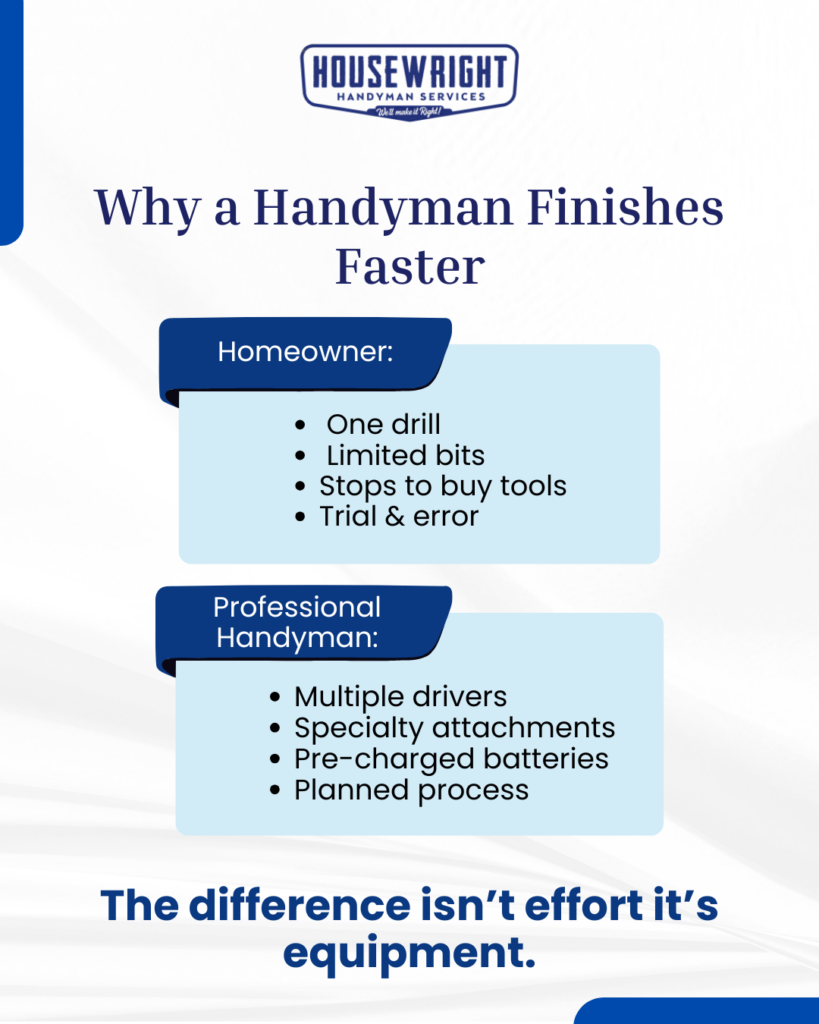
The reason a repair that takes you 5 hours takes a handyman 45 minutes isn’t magic — it’s preparation. A professional arrives with the tools for home repair already organized, charged, and ready.
Homeowners often say: “I installed it… but it looks crooked.”
That’s because professionals rely heavily on measuring and alignment tools:
4-foot and torpedo levels
Laser level
Tape measures (multiple lengths)
Angle finder
Chalk line
Marking gauges
In older Baltimore homes- especially rowhouses in Canton, Hampden, and Federal Hill- floors and walls are rarely perfectly square. A shelf aligned to the wall may actually be tilted.
What this means for you
Professional measuring tools ensure:
cabinets align
doors close properly
shelves don’t lean
mounted TVs look centered
This is the difference between “installed” and “installed correctly.”
Electrical Testing & Safety Tools
Electrical work is where a handyman’s equipment matters most.
Typical electrical tools include:
Voltage testers
Circuit testers
Outlet polarity testers
Wire strippers
Insulated screwdrivers
Non-contact current detectors
These are not optional. They are safety equipment.
Many Baltimore homes still contain older wiring. Without testing, a wire that appears safe may still be live.
What this means for you
A handyman doesn’t guess- he verifies. This protects:
your home
your appliances
your insurance coverage
Plumbing & Leak-Detection Tools
Water damage is one of the most expensive homeowner problems in Maryland.
A handyman typically carries:
Pipe wrenches
Basin wrenches (for sinks)
Plumber’s tape and sealants
Drain snakes/augers
Tub drain removal tools
Moisture detection tools
These allow a leak to be fixed immediately instead of temporarily patched.
Real scenario: A slow leak under a sink in Columbia may go unnoticed for weeks. A handyman can identify early moisture and stop mold growth before drywall damage begins.
Carpentry & Installation Tools
For doors, trim, drywall, and structural adjustments, a handyman uses:
Nail guns
Stud framing tools
Wood chisels
Sanding tools
Clamps
Shimming materials
These are part of a full handyman tools list designed for real repairs, not just quick fixes.
Why this matters
Many Baltimore homes shift slightly over time. Doors stick, trim separates, and frames settle. Fixing this requires carpentry skill and equipment — not just tightening screws.
One of the most common service calls: mounting TVs and shelves.
A handyman uses:
Stud finder
Deep-scan stud locator
Masonry anchors
Toggle bolts
Hammer drill (for brick walls)
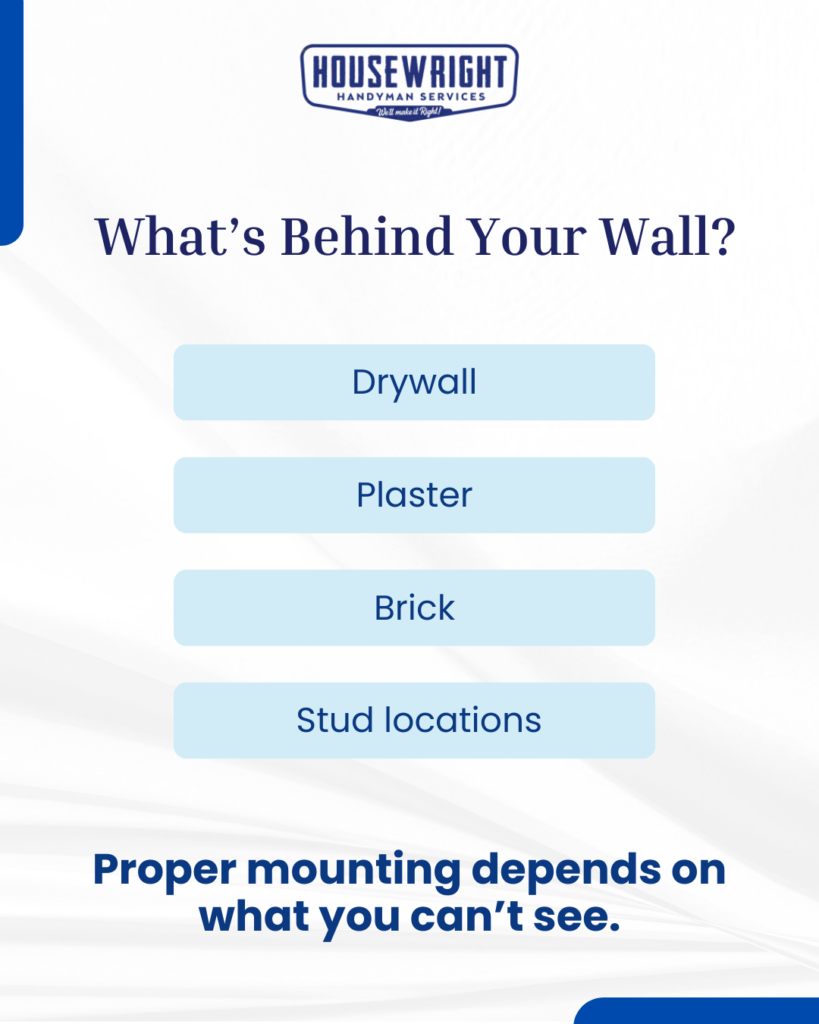
Rowhouses often have plaster or masonry walls, which behave very differently from drywall.
What this means for you
Mounting a TV without finding a stud can pull the wall apart weeks later. A professional ensures the mount is secured into structure- not just drywall.
Ladder & Access Equipment
Professionals also bring safety equipment:
Extension ladders
Stabilizers
Roof access ladders
Safety supports
Many homeowner injuries happen during simple tasks like gutter cleaning or exterior caulking.
A handyman’s residential handyman services include working safely at height.
Specialty Tools Homeowners Don’t Own
This is the hidden value.
Professionals carry tools most homeowners never purchase:
Oscillating cutters for drywall openings
Laser measuring tools
Trim pullers
Specialty fasteners
Adhesive systems
These prevent damage when accessing walls, floors or fixtures.
What This Means for the Homeowner
The real takeaway isn’t the tools themselves.
It’s preparedness.
When you hire a professional, you’re not paying for a person — you’re paying for a mobile workshop that arrives at your door ready for almost any repair.
That’s why many homeowners searching handyman vs DIY tools realize something:
The handyman doesn’t just fix the problem — he prevents the next one.
note multiple small repairs (many homeowners combine tasks into one visit)
Quick Decision Guidance
If the job requires:
drilling
wiring
water connections
mounting
cutting
You’ll likely save time, money, and frustration by hiring a professional.
Instead of spending a weekend learning tools you may never use again, you can have the repair finished properly in a single visit.
A trusted local handyman often completes in one afternoon what homeowners postpone for months — and that peace of mind is usually the real reason people call.
FAQs
Do I need to provide tools to a handyman?
No. A professional handyman arrives with a complete set of handyman repair tools and equipment needed to perform the work. Homeowners typically don’t need to supply drills, ladders, anchors, or hardware. The only thing you may occasionally provide is a specific fixture or product you purchased (for example, a light fixture, faucet, or shelf you want installed).
Does a handyman bring materials or only tools?
A handyman always brings tools and commonly used installation supplies such as screws, anchors, sealants, shims, and fasteners. Larger materials — like a replacement faucet, vanity, or ceiling fan — are usually chosen by the homeowner so it matches your style and budget. However, many residential handyman services can also pick up materials in advance if you request it.
Why does a handyman finish jobs faster than DIY?
Speed comes from preparation and experience. A professional already knows:
which tool to use,
which fastener works best,
and the correct installation sequence.
Instead of stopping mid-project to research or visit a hardware store, a handyman arrives with organized tools for home repair and completes the task efficiently. What takes a homeowner several hours often takes a professional under an hour because mistakes and trial-and-error are eliminated.
What tools do handymen use for drywall repairs?
Typical drywall work involves more than patching compound. A handyman may use:
drywall saws
utility knives
sanding blocks or power sanders
joint knives (multiple sizes)
stud finders
corner tools
repair mesh and backing supports
These tools allow the repair to blend into the wall so the patch disappears after painting, instead of leaving a visible bump or uneven surface.
Can a handyman handle electrical and plumbing tools safely?
Yes — a qualified handyman uses proper safety equipment such as voltage testers, insulated tools, and leak-detection methods. The purpose of these professional handyman equipment items is to verify safety before touching wiring or pipes. If a repair requires a licensed specialist beyond a handyman’s scope, a reputable professional will advise you and not proceed unsafely.
What’s the difference between homeowner tools and professional tools?
Homeowner tools are designed for occasional use. Professional tools are designed for accuracy, durability, and daily work. For example:
a homeowner drill installs a screw
a professional impact driver installs it precisely without stripping
a basic level checks alignment
a laser level aligns an entire wall of cabinets
The difference shows in the results — tighter installations, straighter lines, and longer-lasting repairs.
Will a handyman come prepared for unexpected repairs?
Usually, yes. Experienced handymen carry a wide handyman tools list and extra hardware specifically because homes often reveal hidden issues — loose anchors, damaged studs, corroded valves, or stripped fasteners. Being prepared allows the repair to be completed in one visit instead of postponing the job for another appointment.
If you want to confirm services or describe your repair beforehand, you can contact them directly here: https://housewrighthandyman.com/